
It’s a scenario every driver in Auburn, California, has experienced at least once. You walk out to your car, coffee in hand, ready to start your day. You hop in, turn the key or press the start button, and… nothing. Maybe you hear a frantic clicking sound, or perhaps the engine gives a sluggish, tired groan before falling silent.
In that moment of frustration, your mind immediately goes to the battery. “I need a jump,” you think. But while a dead battery is a common culprit, it isn’t the only component that can leave you stranded. Your vehicle’s electrical system is a partnership between the battery and the alternator. When one fails, the other is often not far behind.
Understanding the difference between a bad battery and a bad alternator can save you from the “parts-darts” game: throwing money at a new battery only to have your car die again two days later because the alternator was the real villain. At Auburn Service Center, we believe in honest diagnostics. Let’s break down how to tell which one is actually killing your car and how you can spot the warning signs before you’re stuck looking for auto repair near me.
The Power Couple: How Your Electrical System Works
To understand the failure, you first have to understand the roles. Think of your car’s electrical system like a professional relay race.
- The Battery is the Sprinter: Its job is short, intense, and vital. It provides the massive burst of “cranking amps” needed to engage the starter motor and turn over the engine. It also powers electronics like the lights and radio when the engine is off.
- The Alternator is the Marathon Runner: Once the engine is running, the alternator takes over. It converts mechanical energy from the engine into electrical energy. This powers your headlights, AC, and infotainment system while simultaneously “topping off” the battery so it’s ready for the next start.
If the battery is the lifeblood of the starting process, the alternator is the power plant that keeps the heart beating. When this cycle is broken, your car effectively begins to run on borrowed time.

Red Flags: Is Your Battery Dying?
Batteries generally have a lifespan of three to five years. In our climate, the heat of a California summer can actually be harder on a battery than the winter chill, as it evaporates the internal liquids and speeds up corrosion.
Here are the classic symptoms of a battery that is reaching the end of its road:
- The “Click-Click-Click” Sound: When you turn the key and hear a rapid-fire clicking, it’s usually the starter solenoid trying to engage but not receiving enough voltage from the battery to stay locked in.
- The Slow Crank: If the engine sounds like it’s struggling to “wake up”: a labored chug-chug-chug before finally starting: your battery is likely weak.
- Dim Lights Before Starting: If your dome lights look yellow and faint before you start the car, but brighten up once the engine is running, the battery is struggling to hold a charge.
- Visible Corrosion: Open the hood. Do you see white, ashy, or blue-green powder around the metal terminals? That’s acid corrosion, which creates resistance and prevents the battery from charging or discharging correctly.
- Age: If you can’t remember the last time you replaced your battery, or the sticker says it’s more than four years old, it’s a prime suspect.
If you are experiencing these issues, it might be time for a comprehensive tune-up to ensure your electrical connections are secure.
The Warning Signs: Is Your Alternator Failing?
A bad alternator is a more “stealthy” killer. Because the alternator is responsible for powering the car while you drive, a failure here can actually be dangerous, as it might cause the car to stall in the middle of traffic.
Watch for these specific signs of bad alternator:
- The Battery Light: This is the most common point of confusion. Many drivers see the “battery” icon on their dashboard and assume the battery is bad. In reality, that light usually indicates a charging system failure: meaning the alternator isn’t producing enough voltage.
- Flickering or Overly Bright Lights: Since the alternator regulates voltage, a failing one can cause your headlights to flicker, dim, or even become unusually bright as the voltage regulator struggles.
- Strange Noises: Alternators have internal bearings. If you hear a high-pitched whining or a grinding sound that gets louder as you accelerate, those bearings might be seizing up.
- Electrical Gremlins: Modern cars are computers on wheels. If your power windows are moving slower than usual, your heated seats aren’t getting hot, or your dashboard display starts acting “glitchy,” your alternator may not be providing consistent power.
- The Smell of Burning Rubber: The alternator is driven by a serpentine belt. If the alternator is seizing or the pulley isn’t turning freely, the friction can create a distinct burning rubber smell.

The DIY Litmus Test: Battery vs. Alternator
If you’re stuck in your driveway, there is a simple “triage” test you can perform to help narrow down the culprit. All you need is a pair of jumper cables and a “donor” car.
- Jump-start the vehicle.
- Once it starts, remove the jumper cables immediately.
- Wait and observe.
The Result:
- If the car stays running and you can drive it to our shop, the problem is likely the battery. The alternator did its job of taking over the electrical load once the engine was forced to start.
- If the car dies shortly after removing the cables, or if it stalls the moment you put it in gear, the problem is almost certainly the alternator. The battery was dead, you gave it a “life support” jump, but the alternator couldn’t keep the engine running on its own.
Note: While this test is helpful, it isn’t foolproof. A modern vehicle’s computer system is sensitive. We always recommend a professional voltage drop test to be 100% sure.
The Chain Reaction: How One Kills the Other
At Auburn Service Center, we often see customers who wait too long to address a weak battery. They think, “I’ll just jump it every morning until I get paid.”
Here is the honest truth: A bad battery will eventually kill your alternator.
When a battery can no longer hold a charge, the alternator has to work at 100% capacity at all times to compensate. It was never designed to run at maximum output constantly. This creates excessive heat, wears out the internal brushes, and eventually causes the alternator to burn out. Conversely, a bad alternator that overcharges or undercharges a battery can “cook” the battery’s internal cells, leading to permanent failure.
This is why regular general maintenance is a strategic financial investment. Replacing an $180 battery is much cheaper than replacing both the battery and a $600 alternator because you waited too long.

Why Proper Diagnosis Matters in Auburn
Driving in Placer County presents its own sets of challenges. Between the hills of Auburn and the fluctuating temperatures, your vehicle’s charging system is under constant stress. If your alternator fails while you’re climbing a steep grade or navigating the I-80, you lose power steering and braking assistance, which can turn a mechanical failure into a safety emergency.
If your check engine light or battery light has come on, don’t ignore it. There are 7 mistakes you’re making when your check engine light comes on, and assuming it’s “just a glitch” is the biggest one.
What Should You Do Next?
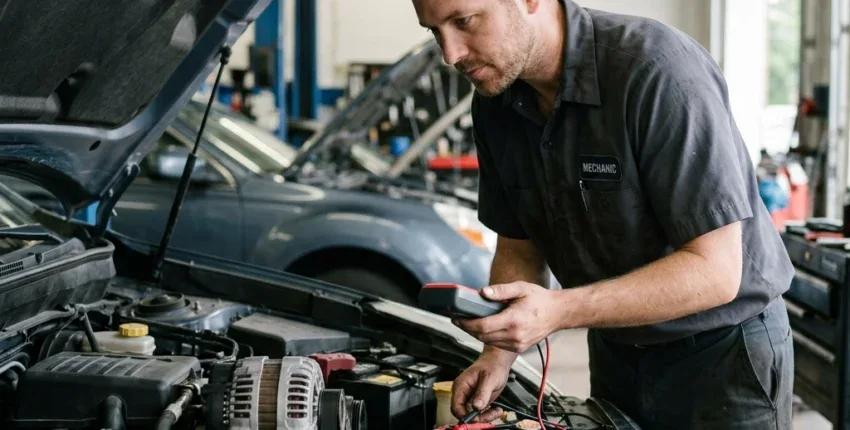
If you suspect your car is struggling to start or you’ve noticed the signs of bad alternator, the best move is to get a professional charging system test. At Auburn Service Center, we don’t just look at the battery; we test the starter’s draw, the alternator’s output under load, and the health of your battery cells.
We pride ourselves on being the go-to for top auto repair services in Placer County, CA. We won’t sell you a part you don’t need. If it’s just a loose belt or a corroded wire, we’ll tell you exactly that.

Don’t wait until you’re stranded at the grocery store or late for work. If your car is giving you “the silent treatment” or acting sluggish, come see us. We’ll perform a full diagnostic to see which component is actually “killing” your car and get you back on the road with confidence.
Ready to get your charging system checked?
Contact us today or visit our automotive repair services page to learn more about how we keep Auburn drivers moving safely.