
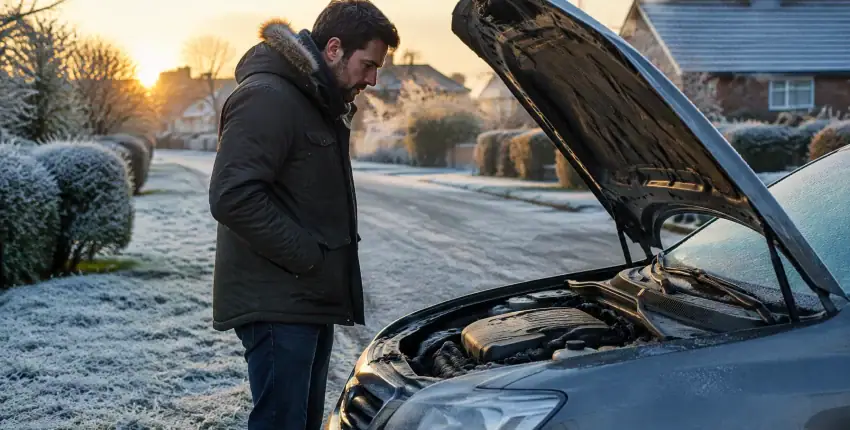
It’s the morning you’re already running late. Frost on the windshield, breath fogging in the air, you turn the key and get a slow, tired click-click-click instead of the engine catching. On a cold morning like this, a car that won’t start usually has a battery problem. Cold weather doesn’t kill a healthy battery, but it exposes a weak one fast.
The good news: in most cases you can get moving again in fifteen minutes with a jump-start, if you do it safely. Here’s what’s actually happening on those cold mornings, how to jump-start a car the right way, and how to tell when a jump is a fix versus just a delay.
Why Cold Mornings Kill Weak Batteries
A car battery works by a chemical reaction inside it. Cold slows that reaction down. At freezing temperatures, a fully charged battery can deliver noticeably less cranking power than it does on a warm day, while the engine simultaneously becomes harder to turn because the oil inside it has thickened. More demand, less supply, all at the exact moment you’re already late.
That’s why a battery that seemed fine in October can suddenly leave you stranded in January. It was marginal all along; the cold just pulled the curtain back. If you’re weighing whether the battery or the alternator is the real culprit, we break down that diagnosis in our guide to bad battery vs. bad alternator.
Other Cold-Morning Culprits Worth Ruling Out
The battery is the most common cause, but not the only one. If your battery tests healthy, these are the next suspects:
- Thick, old engine oil makes the engine harder to crank, especially in high-mileage cars that are overdue for an oil change — if you’re unsure where your intervals should land, our post on how often you really need an oil change covers it
- Corroded battery terminals add resistance right where you need clean contact most — a white, crusty buildup on the posts is the giveaway
- A failing starter motor tends to act up more in cold weather, and often gives warning clicks or slow cranking before it quits completely
If the car cranks strongly but just won’t fire, that’s a different problem entirely (fuel or spark, not power), and that’s a job for a shop rather than jumper cables.
How to Jump-Start a Car Safely, Step by Step
If you have jumper cables and a willing neighbor or a portable jump pack, here’s the safe way to do it.

Before You Start
- Inspect the dead battery first. If it’s cracked, leaking, or smells like rotten eggs, do not jump it — that battery needs to be replaced, not revived
- Make sure both cars are in Park (or in gear with the parking brake set, for a manual) with both engines off
- Never smoke or allow sparks near the battery
- Untangle the cables and keep the red and black clamps from touching each other once they’re connected to a battery
The Connection Order
- Red clamp to the dead battery’s positive (+) terminal
- Red clamp to the good battery’s positive (+) terminal
- Black clamp to the good battery’s negative (–) terminal
- Black clamp to an unpainted metal surface on the dead car’s engine bay — a bolt head or bracket works, away from the battery itself. This keeps sparks away from the battery gases
Starting and Disconnecting
Start the donor car and let it run for a couple of minutes to put some charge into the dead battery. Then try the dead car. If it cranks and catches, let it run. Once both cars are running, disconnect the clamps in the exact reverse order you put them on: black off the engine block first, black off the donor battery, red off the donor, red off the revived battery. Keep the clamps from touching during removal.
Common Mistakes to Avoid
- Mixing up the order — positive before negative matters, and the final clamp goes on the engine block, not the dead battery
- Letting the clamps touch each other while connected, which creates a short circuit
- Jumping a visibly damaged or leaking battery
- Revving the donor car aggressively — it doesn’t help and adds stress to its alternator
After the Jump: Quick Fix or Real Repair?
A jump-start gets you moving, but it doesn’t tell you why the battery died. Here’s how to read the situation:
If the battery died because you left the lights on, you’re probably fine. Drive for a good while, or better yet put a charger on it overnight, and the battery should recover.
If the car started with a jump but dies again later, or won’t start the next cold morning, the battery itself is likely worn out. Batteries typically last several years, and a battery that can’t hold a charge after a jump is telling you it’s done.
If the car runs but the battery warning light stays on, or you notice dim lights and slow accessories while driving, the charging system (alternator or its connections) may not be recharging the battery at all. In that case, another jump just delays a tow — and a warning light you can’t explain is worth reading up on, so see our guide to what your check engine light means.
One cold-morning no-start is an inconvenience. A pattern of them is a diagnosis waiting to happen.
When to Have It Checked
If your car needed a jump this morning, or it’s been cranking slower than usual as the weather’s turned, the battery and charging system should be tested before the next freeze — not after. A battery test takes minutes and tells you whether you’re looking at a battery replacement, a charging problem, or just an old battery reaching the end of its life.
If you’re in Auburn, CA and searching for an auto repair near me, Auburn Service Center can test your battery and charging system for free as part of our inspection. We’re family-owned, we quote upfront before any work is done, and qualifying repairs are backed by a 24-month/24,000-mile NAPA AutoCare warranty on parts and labor. Call us at (530) 888-1001 or book an inspection online, and start the next cold morning with an engine that fires right up.